

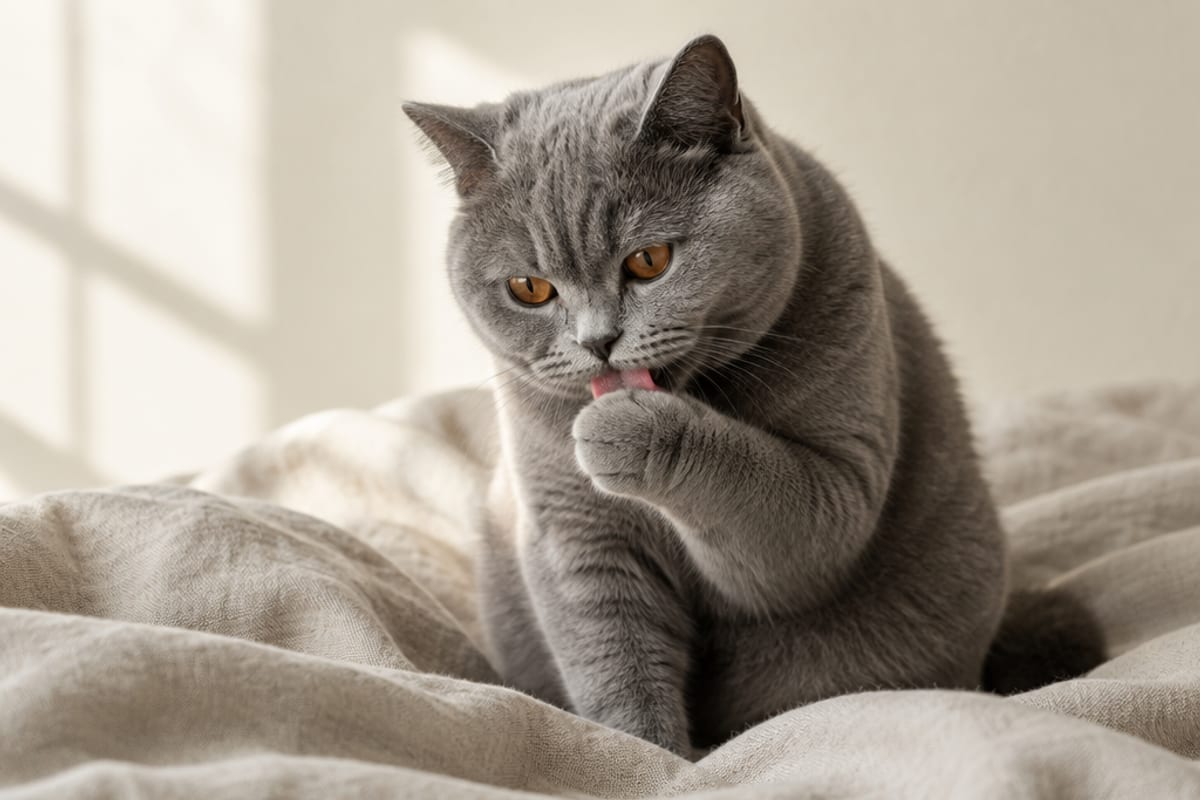
When a cat cannot manage alone
Older or overweight cats that cannot reach their back. Long-haired cats whose coat mats faster than they can groom it. Cats that have got into something: oil, paint, litter clumped in the fur, or anything you do not want licked off. Cats recovering from illness who have stopped grooming. And the occasional indoor cat with a greasy coat along the spine.
Start without water
A no-rinse foam or a damp cloth handles most of the above. Work it through the coat in the direction the fur lies, then towel. There is no rinsing and no wet cat, which is why it works: the cat tolerates it, and you are not soaking a coat that takes hours to dry.
If a full bath is unavoidable
Trim the claws first. Use a sink or a shallow basin with a towel on the bottom so the cat has grip. Lukewarm water, a small amount of a wash made for cats, and speed: wet, wash, rinse, done. Keep water away from the face and ears. Towel dry and keep the cat somewhere warm until fully dry. One person to hold, one to wash, is realistic.
Why dog products are the wrong choice
Cats groom everything off their coat within the hour, so whatever you apply is swallowed. Many dog products, and most 'natural' ones, contain essential oils that cats cannot metabolise. A product for cats is formulated on the assumption that it will be eaten. That is the whole difference.
Signs that it is not a grooming problem
A cat that has stopped grooming, or grooms one spot until it is bald, is telling you something. Pain, stress, skin parasites and dental problems all show up as changes in grooming. Those are vet questions, not bath questions.